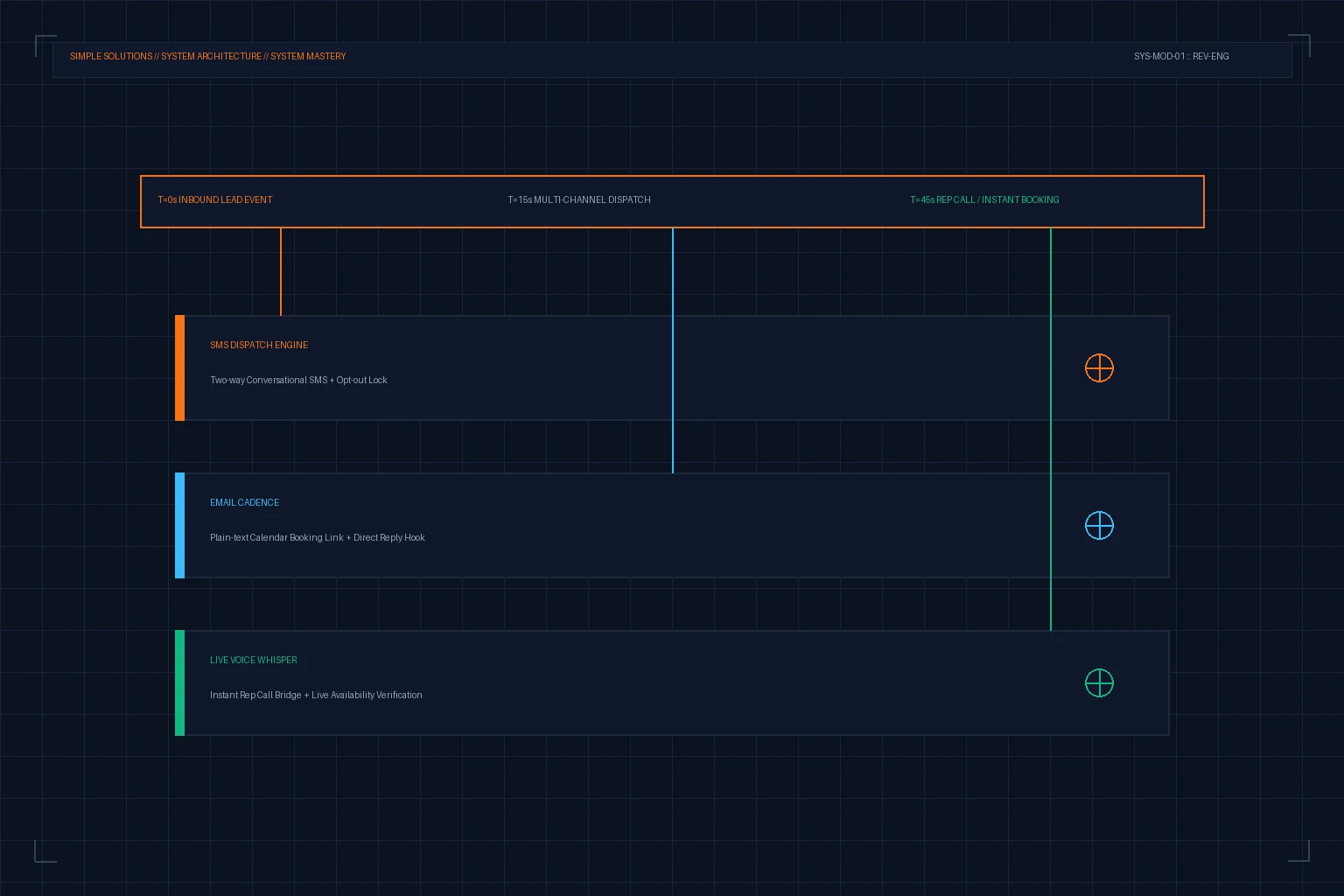
Speed to lead is not a race to send the fastest generic acknowledgement. It is a response system that accepts an enquiry once, chooses an eligible channel, assigns an accountable owner, and creates a recoverable next step. A sub-minute target can be useful for the automated portion, but the target must be measured against the team's real staffing, consent rules, source quality, and ability to continue the conversation.
Define separate automation and human-response SLAs
Measure at least four timestamps: source event received, acknowledgement accepted by the channel provider, owner assigned, and first meaningful human action. Set an automation objective for capture and acknowledgement, then a different service-level objective for a representative to reply, call, or accept the handoff. This prevents a fast email receipt from being reported as a successful response while the opportunity remains unowned.
Normalize and validate the intake event
Convert every form, chat, call, and partner lead into one intake contract containing a source event ID, received-at timestamp, identity fields, consent evidence, requested service, location or time zone, and raw-source reference. Validate required fields before creating downstream work. Store the source event ID as an idempotency key so retries and duplicate submissions update the same intake record instead of creating competing opportunities and messages.
Choose channels from evidence, not convenience
Build an eligibility decision before dispatch. SMS requires a usable mobile number and consent appropriate to the jurisdiction and use case; email requires a valid address; live calling requires an available owner and an acceptable local-time window. Record why each channel was selected or suppressed. The first message should identify the business, acknowledge the specific request, offer one useful next step, and make reply or opt-out behavior clear.
Fast outreach is useful only when the system can explain who was contacted, on what basis, by which channel, and what should happen next.
Route by capacity and preserve one accountable owner
Round-robin alone distributes names, not work. Exclude unavailable representatives, cap the number of unworked enquiries per owner, and use territory or service eligibility before choosing among the remaining candidates. Claim the lead with an atomic update so two workers cannot assign different owners. If no eligible owner exists, place the enquiry in a visible exception queue rather than pretending assignment succeeded.
Cancel automation when the state changes
Every delayed message should re-check current state immediately before sending. Stop or branch the sequence when the contact replies, opts out, books, is disqualified, or is claimed by a representative. A manual call should emit the same state-change event as an automated action. This shared cancellation contract prevents a prospect from receiving a nurture message moments after speaking with the team.
Design the after-hours and failure paths
After hours, state the next staffed response window and offer self-service scheduling only when availability is authoritative. If the CRM, messaging provider, or calendar is unavailable, retain the intake event, retry only the failed side effect, and alert on aged unacknowledged leads. Never retry the entire workflow after a partial success; doing so can repeat messages or recreate opportunities.
The benchmarks: what the data actually says
A sub-minute workflow is not a vanity target; it is backed by two decades of lead-response research. The original InsideSales study found that contacting a lead within five minutes made the business 100 times more likely to reach the person and 21 times more likely to qualify the lead than waiting thirty minutes. More recent analyses show conversion odds roughly 21 times higher in the first five minutes than in the first hour, and response within one minute outperforming responses within two minutes by a wide margin. The uncomfortable context is that most businesses are slow. Average B2B first-response times are measured in days, and only around a quarter of companies respond within five minutes at all. A sub-minute automated acknowledgement therefore moves a business from the bottom of the distribution to the top without adding staff. The benchmark that matters is the gap between automated acknowledgement and first meaningful human action; the automation layer must hold the lead warm while the human layer closes it, because a fast generic receipt followed by three days of silence still loses the opportunity.
A worked example of the cost of slowness
Put the numbers on a single lead source to make the argument concrete. A service business receives 100 enquiries per month and closes 10 percent of contacted leads at an average value of $500 per job, so a fully contacted month produces $5,000 in revenue. If only half of those enquiries are actually reached because responses slip past the five-minute window, the same source produces roughly $2,500, and the difference of $2,500 per month, or $30,000 per year, is the direct cost of response latency. Automation does not change the price of the job or the quality of the traffic; it changes the proportion of enquiries that become contacted leads, which is the multiplier applied to everything downstream. The same arithmetic works at any scale: multiply monthly enquiries by average deal value, by the contact-rate gap between current speed and target speed, and the result is the monthly revenue recovery available from the workflow described above.
How to measure your own baseline
Before changing anything, measure the current state honestly, because every improvement claim needs a starting point. Record the four timestamps defined earlier for a full week of enquiries, then compute the median and the 90th percentile for each interval; the median describes the typical experience while the 90th percentile exposes the worst cases that generate the most complaints. Split the results by source, because a website form, a missed-call lead, and a partner referral usually have very different current speeds and different realistic targets. Report the numbers weekly in one short review: acknowledgement latency, owner-assignment latency, unowned lead age, and duplicate-message rate. Those four figures decide whether the automation rollout is accelerating or merely adding noise.
Prove the workflow with adversarial tests
Test duplicate delivery, missing consent, invalid phone formatting, weekend and time-zone boundaries, simultaneous owner claims, provider timeouts, calendar conflicts, replies arriving during a delay, and opt-out propagation. Monitor acknowledgement latency, owner-assignment latency, unowned lead age, duplicate-message rate, provider rejection rate, and first meaningful response. Release gradually by source so failures can be isolated and rolled back without disabling every intake path.