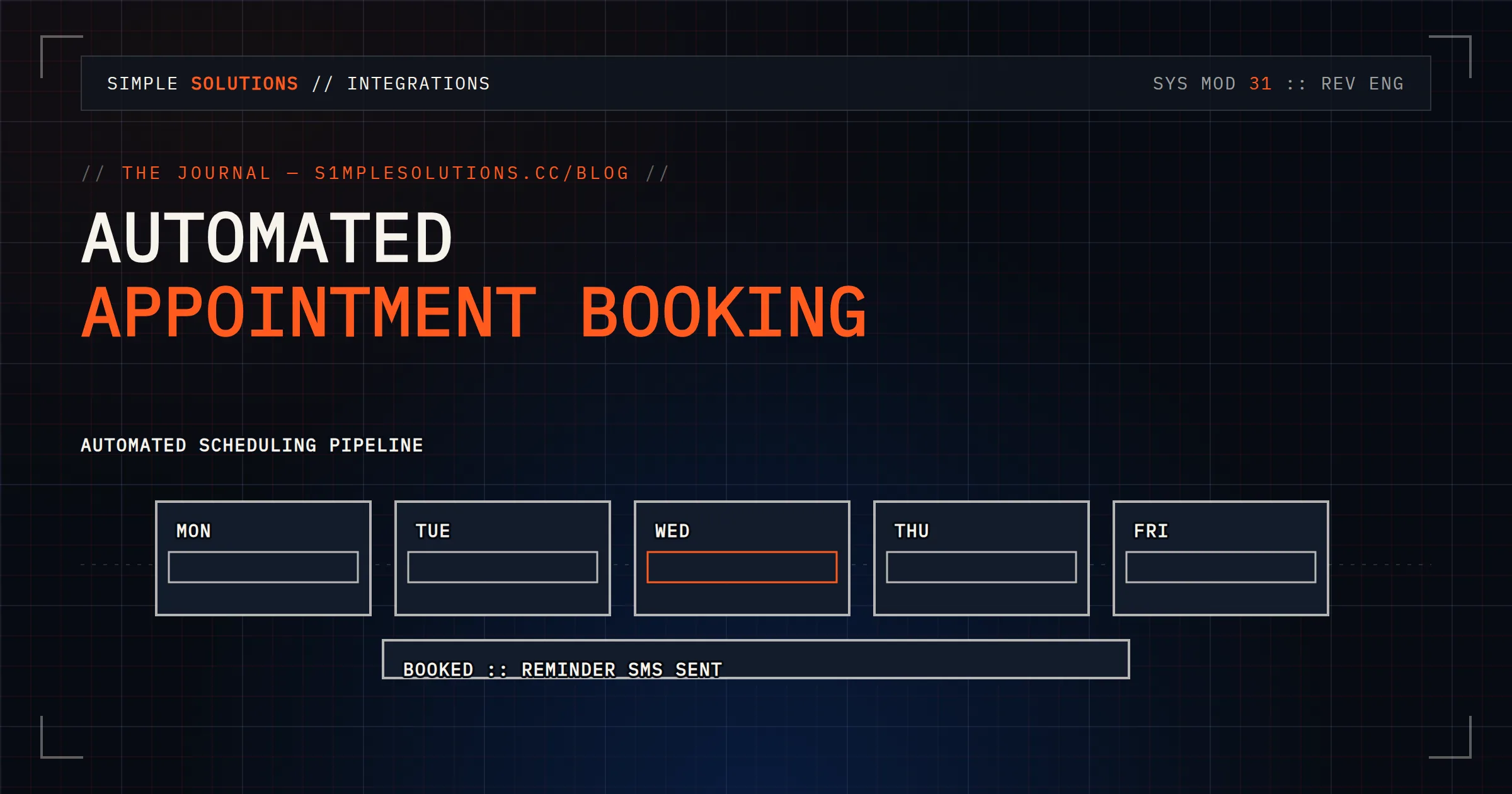
The single fastest conversion improvement most teams can make is removing the email volley around scheduling. Every back-and-forth costs you a percentage of your pipeline.
Direct Booking Beats Discovery Calls
Letting qualified leads book directly into a rep's calendar — with smart routing logic — outperforms "book a discovery call" forms by an order of magnitude.
Reminders Win Back No-Shows
A 24-hour SMS, a 1-hour email, and a 5-minute "we're ready when you are" ping cuts no-shows by more than half. Automate the entire ladder.
Connect the Calendar to the CRM
Every booking should auto-create a deal, assign an owner, and trigger a pre-meeting brief. The calendar is the front door of the pipeline; treat it that way.
What no-shows actually cost, in numbers
The no-show problem is bigger than most teams calculate because it compounds at every layer. Typical industries lose 20 to 35 percent of booked appointments to no-shows, with healthcare practices often at the top of that range, and the loss is not merely the meeting: it is the preparation time already spent, the calendar slot blocked for other demand, and the follow-up work of rescheduling, which usually halves the chance the meeting happens at all. A service business with 20 bookings per week at a 15 percent no-show rate and $200 average meeting value loses roughly $31,000 per year in missed meetings before counting the downstream deals those meetings would have produced. Against that, the automated ladder costs minutes to run: a 24-hour SMS confirmation with a one-tap reschedule link, a same-morning reminder that includes the agenda, and a 15-minute send-off. Studies of reminder programs consistently show 24-hour reminders roughly halve no-show rates and SMS outperforms phone calls because the recipient acts immediately instead of flagging the call to ignore later. The reschedule link is the underrated half: making it easier to move a meeting than to skip it converts most soft no-shows into held appointments.
Route bookings by rule, not by fairness
Direct booking only beats manual scheduling when the routing logic matches the meeting to the right person, because a booked meeting with the wrong rep is a slow leak rather than a win. The common patterns: territory routing by postcode or region keeps travel efficient and relationships local; skill routing by service type sends a technical enquiry to the engineer who can actually answer it; capacity routing respects current load so no single rep absorbs the queue while others sit idle; and urgency routing escalates same-day or emergency requests outside the normal calendar. The rule set should be written down per business before any automation is configured, because the configuration merely encodes the policy, and a policy nobody wrote down produces a calendar nobody can explain. Review the routing quarterly against outcome data: which routes convert, which reschedule, and where bottlenecks accumulate.
Automate the work around the meeting, not just the meeting
The highest-leverage automation sits in the hours adjacent to the booking. Before the meeting: the CRM assembles a brief from the enquiry history, fills it with the source, the questions asked, and the documents shared, and delivers it to the rep and the shared calendar event automatically. After the meeting: the system logs the outcome, advances or recycles the deal by the result, schedules the next touch if one was promised, and fires the follow-up sequence while the conversation is still warm. Between meetings that never happened: the no-show flow runs its recovery ladder without anyone remembering to check. Each of these is small alone, but together they remove the administrative memory burden that currently consumes the first and last fifteen minutes of every rep's day, and that time returns to selling instead of to note-taking. The test of success is simple: after two weeks of automation, the rep should be able to join a meeting fully briefed without having opened a single task list beforehand.