An integration is not reliable because it worked during setup. It is reliable when duplicate events, temporary outages, invalid records, rate limits, schema changes, and partial failures produce controlled outcomes. The design objective is not to eliminate every failure. It is to prevent silent corruption and make recovery routine.
Choose ownership and event direction
Assign a system of record for each entity and field before synchronizing anything. The CRM may own contact lifecycle and sales ownership; billing may own invoices and payment status; delivery may own project completion. Define which events cross each boundary and whether the receiving system may write back. Without ownership, two-way sync becomes an argument in which the most recent write wins accidentally.
Make repeated requests safe
Networks retry and webhook providers redeliver. Give each business event a stable identifier and record whether it has already been processed. The same form submission, payment event, or appointment change should produce the intended result once even if the message arrives multiple times. Idempotency must cover side effects such as sending messages, creating opportunities, and charging accounts—not only database writes.
Retry only recoverable failures
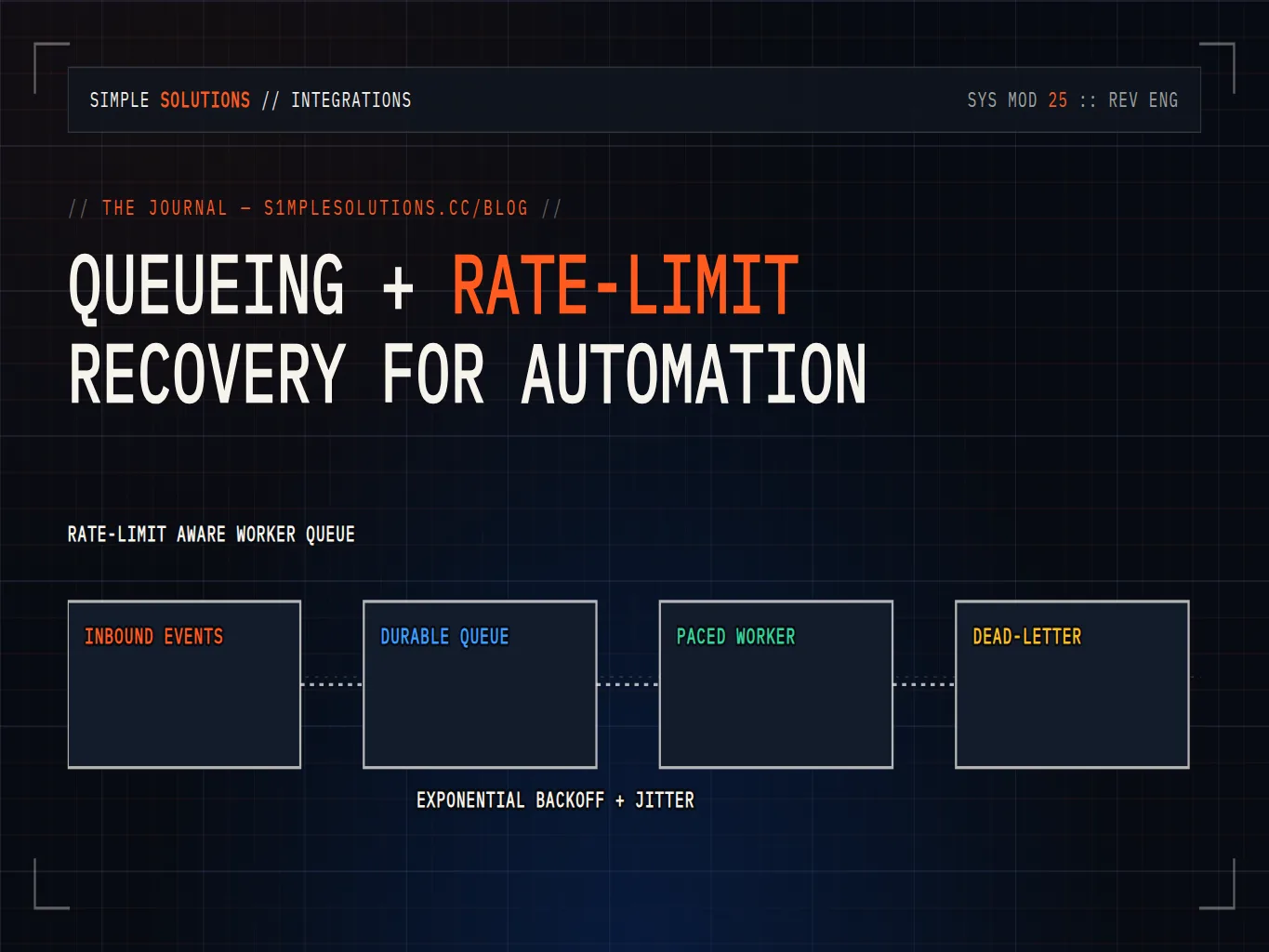
Use bounded retries with increasing delay for timeouts, rate limits, and temporary server errors. Do not repeatedly retry validation failures, missing required fields, or rejected permissions; move those records to a review queue with the exact cause. Respect provider retry guidance and preserve the original event payload so later processing does not depend on data that has since changed.
A retry policy without an idempotency policy is a duplicate-data generator.
Record an operational event ledger
Log the correlation identifier, source event, destination action, sanitized request, response status, attempt count, timing, and final state. Avoid storing secrets or unnecessary personal information. The ledger should answer: what happened, which record was affected, whether it will retry, and what an operator should do next. A dashboard without record-level traceability is not observability.
Plan for partial completion
Multi-step workflows can stop after step three of five. Decide whether completed actions should remain, be compensated, or be resumed. Creating a CRM contact may be safe to keep when appointment creation fails; sending a confirmation is not safe until the booking succeeds. Store checkpoint state so recovery can continue from the correct step rather than replaying the entire process.
Test failure as deliberately as success
Simulate timeouts, duplicate events, changed field formats, expired credentials, rate limits, unavailable dependencies, and operator replays. Alert on sustained failure rate, growing queue depth, aged unresolved events, and reconciliation mismatches. Schedule a comparison between systems for critical records. Reliability is a maintained operating capability, not a one-time development property.