A pipeline is both a work queue and a forecast model. It fails when stages describe optimism instead of evidence, records have no next action, or stale opportunities remain active because nobody owns the decision to close or recycle them. Governance should make uncertainty visible without forcing every unusual deal through an inflexible happy path.
Write a contract for every stage
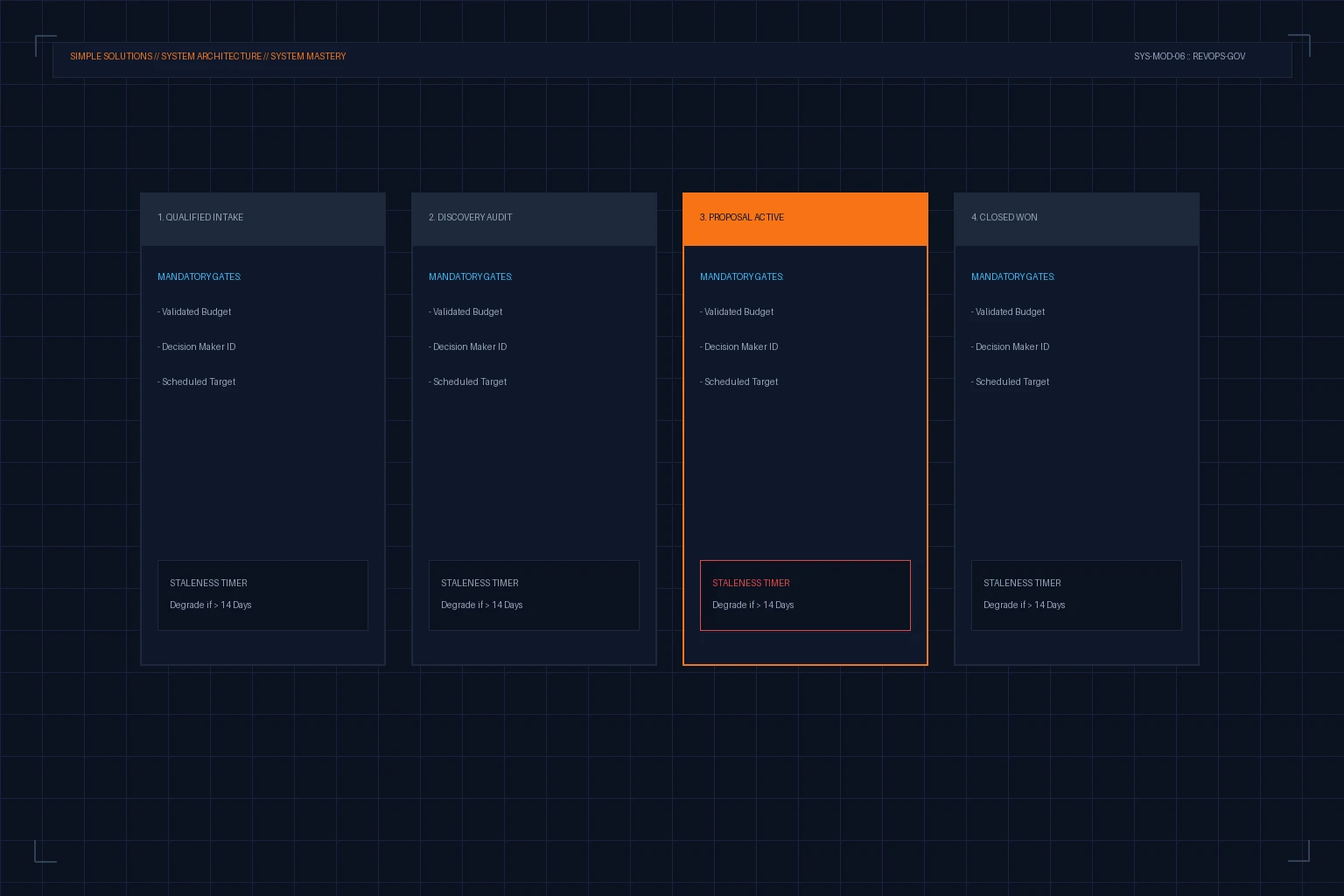
For each stage, document its purpose, entry event, required evidence, accountable role, expected next action, exit events, and allowed exception path. Prefer events such as meeting attended, technical review accepted, proposal delivered, or procurement started over labels such as warm or promising. Store the evidence link and transition timestamp so operators can audit why the record moved.
Separate qualification from sales progress
Qualification fields describe whether the opportunity fits; stage describes what has happened in the buying process. Do not advance a poor-fit deal merely because a meeting occurred, and do not leave a qualified opportunity in discovery after a proposal was delivered. Model fit, buying event, next action, and forecast category separately so one overloaded stage field does not answer four different questions badly.
Use hard gates only for decision-critical data
Require fields that change routing, risk, reporting, or the next customer action. A proposal stage may need the proposal reference, value, currency, recipient, delivered-at timestamp, and follow-up date. Decide whether each missing field blocks the transition, creates an exception, or merely warns the owner. Hard-blocking every optional field encourages placeholder data and workarounds.
A stage gate should protect a real downstream decision, not reward the CRM for collecting more fields.
Derive aging thresholds from observed cycles
Measure time in stage by segment, deal type, and outcome before choosing thresholds. Alert first when the next action is overdue or the stage exceeds an agreed percentile; then require the owner to advance, reschedule, recycle, or close the deal with a reason. Automatic movement can be appropriate for deterministic states, but ambiguous or high-value opportunities should enter a review queue rather than being silently reclassified.
Preserve closed, lost, and recycled outcomes
Use a controlled loss taxonomy with a short evidence note, effective date, and competitor or timing detail only when known. Keep recycled opportunities distinct from confirmed losses and assign a review date based on the stated buying window. Any nurture must respect the contact's consent and channel eligibility. Reopening should create a new event history rather than erase the original outcome. Loss reasons deserve as much discipline as loss counts, because a loss report dominated by generic reasons teaches nothing, while a honest distribution of price, competitor, timing, no decision, and disqualified tells the sales leadership where the process genuinely loses. Review the loss distribution quarterly alongside win-rate trends; a rising disqualified rate usually indicates the intake or qualification rules need tuning, and a rising timing loss rate usually indicates the sales motion is too slow for the buying window.
Forecast from cohorts and transition history
Report stage conversion, time in stage, slipped close dates, forecast-category movement, value changes, and no-next-action rate by comparable cohort. A pipeline-velocity formula can be a useful summary, but it hides distribution and data quality. Forecast reviews should expose missing evidence and unusual aging alongside the aggregate number so leaders can distinguish true demand changes from record-maintenance changes. The useful discipline is to forecast the committed category separately from the pipeline total: committed deals carry evidence and a date, and everything else is a range the review team states explicitly rather than pretends is a number.
Run a weekly pipeline review that owns the uncertainty
Governance documents are inert without a recurring ritual that enforces them, and the weekly pipeline review is that ritual. Give it a fixed owner, a fixed duration, and a fixed agenda: every opportunity without a next action, every record that exceeded its stage aging threshold, every slip of a committed close date, and every record whose forecast category moved without a new event. The review is a decision meeting, not a status readout; each flagged record leaves with one of four dispositions, advance with evidence, reschedule with a date, recycle to a defined earlier stage, or close lost with a taxonomy reason and effective date. Deal with stale optimism explicitly rather than letting records float indefinitely, because a pipeline where nobody forces decisions is a pipeline whose total value is decoration. Track two health measures over time: the percentage of opportunities with a next action, which should stay near total coverage, and the percentage of closed-lost reasons that are genuinely known rather than defaulted, which measures whether the taxonomy is being used honestly.
Forecast from cohorts and transition history
Report stage conversion, time in stage, slipped close dates, forecast-category movement, value changes, and no-next-action rate by comparable cohort. A pipeline-velocity formula can be a useful summary, but it hides distribution and data quality. Forecast reviews should expose missing evidence and unusual aging alongside the aggregate number so leaders can distinguish true demand changes from record-maintenance changes.
Test governance without disrupting active deals
Run new rules in report-only mode first. Sample proposed violations with sales operators, identify legitimate exceptions, and measure how often fields are unavailable because of process design rather than rep behavior. Then enable gates by stage, retain an audited override path, and monitor blocked transitions, placeholder values, stage reversals, stale-record age, and forecast variance. Review the contract whenever the sales process changes.