A feature flag for business automation should describe an operational capability: new lead router, revised reminder policy, or agent-assisted qualification. Define the enabled behavior, excluded behavior, owner, expiry, and rollback effect. Avoid a collection of unexplained booleans that operators cannot safely interpret. The flag should answer which version of the decision is active for which cohort and why.
Choose cohorts that limit blast radius
Start with internal records, a low-risk source, one region, or a small group of consenting customers. Choose a cohort key that remains stable across retries so the same record does not switch behavior mid-workflow. Exclude records with unresolved exceptions or high commercial risk until the path is proven. A percentage rollout is only useful when the assignment is deterministic and the team can identify affected records.
Separate activation from migration
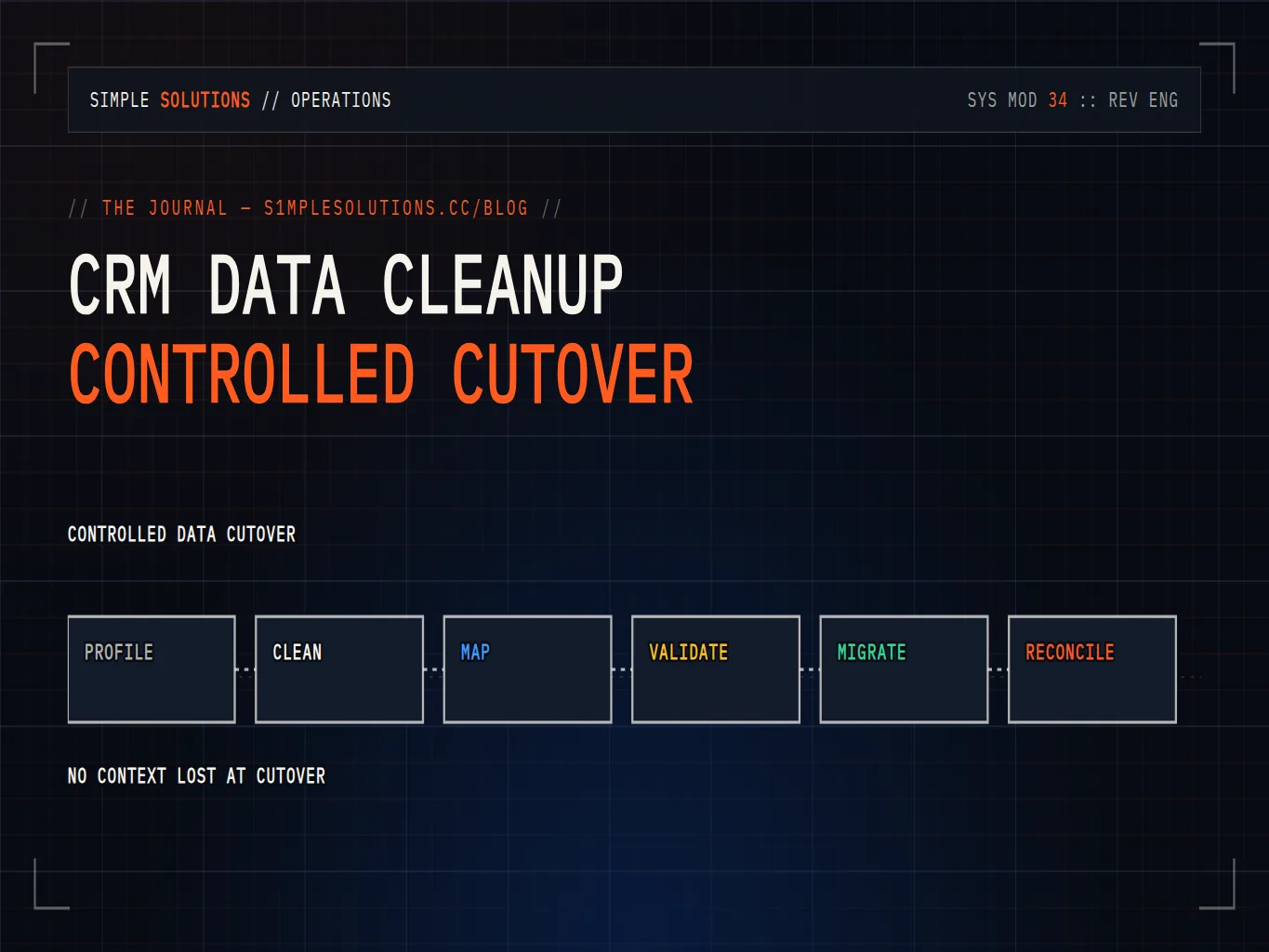
Turning on new decision logic does not migrate records already inside an old workflow. Define how in-flight jobs complete, pause, or hand off. Store the policy version on each run so retries use the intended behavior. For data changes, perform a controlled migration with a dry run and reconciliation rather than assuming the feature flag can repair historical state. This separation makes rollback less destructive.
Build a real kill switch
A kill switch must stop the risky side effect while preserving intake and diagnostic visibility. Place it immediately before message send, external mutation, or agent tool execution, not only at the start of the job. Decide what happens to queued work: cancel, hold, or route to a human queue. Test the switch under partial failure and document who may use it, what signal triggers it, and how normal operation resumes.
Record exposure and decision context
Log flag evaluation with the record identifier, cohort, policy version, decision inputs, and resulting branch. Do not log sensitive payloads unnecessarily. When an incident occurs, the team should be able to list which customers received the new behavior and which did not. This record also lets product and operations compare outcomes without confusing a control group with records that simply failed before evaluation.
Define success and stop conditions
Before enabling a cohort, define the measures that indicate a healthy release and the thresholds that pause it. Include technical signals such as error and retry rates, plus business signals such as unowned work, duplicate messages, customer corrections, or missed appointments. Do not rely on aggregate averages that hide one source or tenant. A release plan should name the observation window, reviewer, and decision meeting or written checkpoint.
Retire flags after the rollout
A feature flag is temporary control infrastructure, not a permanent configuration database. Once the new behavior is stable, remove old branches, tests, dashboards, and documentation that no longer apply. Record the final policy version in the changelog and preserve the exposure history. Stale flags create contradictory paths and make future incidents harder to reason about, especially when different teams assume different defaults.
Pair rollout controls with communications
A safe rollout has an operator-facing announcement, a named monitoring window, and a decision record. Before enabling a cohort, tell support what changed, which customers are included, what symptoms may appear, and how to pause the behavior. Keep a short list of representative records that can be inspected without exposing unnecessary customer data. During the window, compare the treatment cohort with a stable control where possible, but do not sacrifice a customer outcome merely to preserve experimental purity. If the new path sends messages or changes records, capture the exact policy version in the customer timeline. When a flag is paused, create a reconciliation task for work that was held or partially completed. After the rollout, document the observed impact and delete temporary dashboards and exceptions. This discipline prevents feature flags from becoming invisible operations debt. The strongest control is a combination of deterministic assignment, a tested kill switch, exposure evidence, and a communication path that lets non-engineering operators act without editing configuration files or asking for an emergency deployment.
Close the rollout with evidence
At the end of the observation window, record the final cohort, control definition, incidents, customer corrections, and the reason for enabling or reverting. Link the flag cleanup change to that decision. This creates a durable release history that future operators can trust instead of inferring behavior from a stale dashboard or an unexplained configuration value.