Asynchronous operations work when the system records state clearly enough that people do not need a meeting to reconstruct it. The objective is not to eliminate conversation. It is to remove routine status collection, surface exceptions early, and reserve synchronous time for decisions that genuinely require negotiation, judgement, or rapid coordination.
Choose one operational record for each kind of work
Define where the authoritative status, owner, due date, dependency, approval, and outcome live for projects, requests, incidents, and client deliverables. Chat can notify and discuss, but it should link back to the record rather than become a second status database. If two tools may change the same field, document the direction of synchronization and which update wins.
Model transitions as evidence-backed events
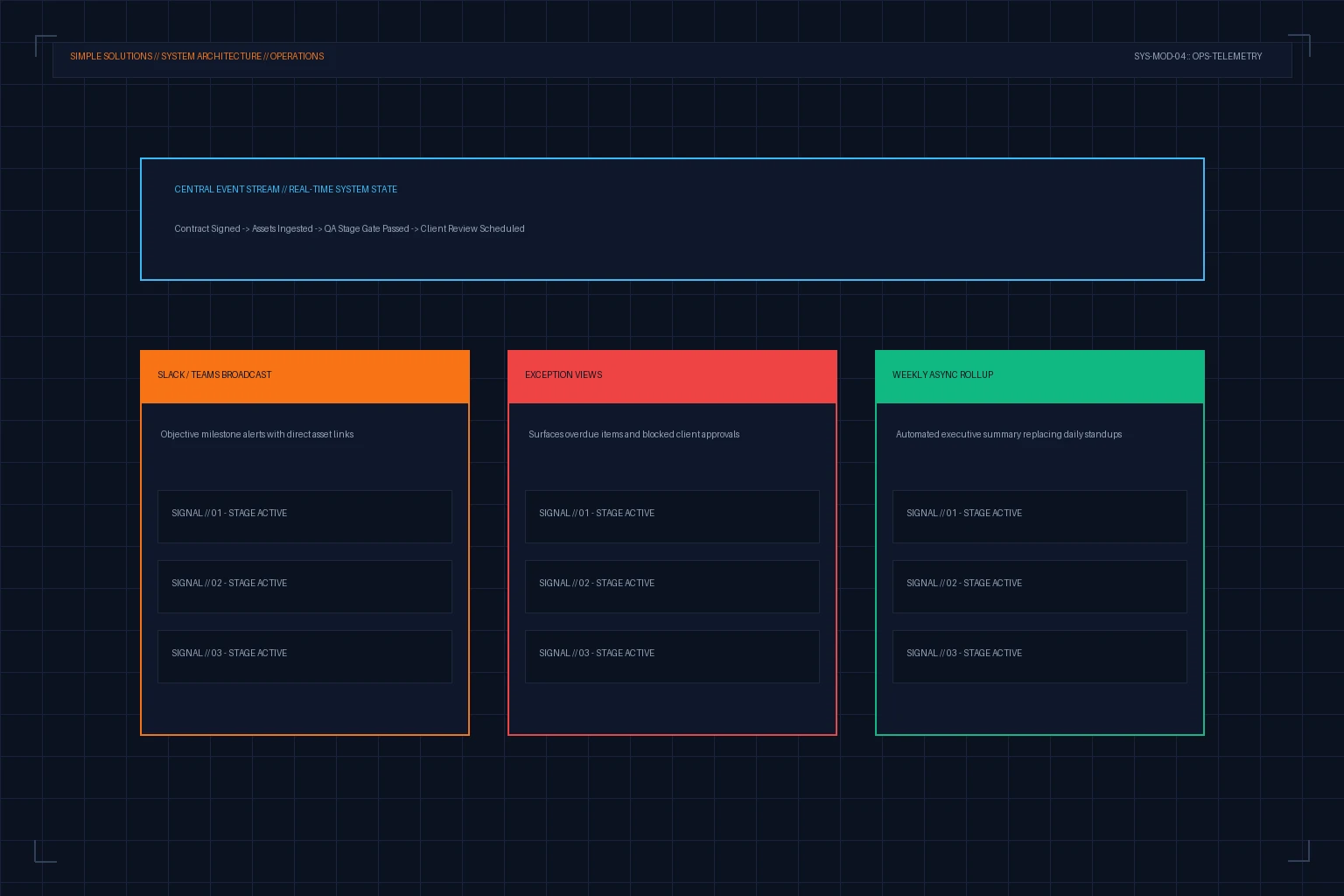
A status label is useful only when its entry criteria are observable. A deliverable enters review when an artifact link, reviewer, and due time exist; it becomes approved when the named approver records a decision; it becomes blocked when a dependency and next owner are identified. Emit transition events containing record ID, previous and new state, actor, timestamp, evidence link, and correlation ID so automations and audits share the same facts.
An async update should identify what changed, who owns the next action, when it is due, and where the evidence lives.
Build exception queues, not activity feeds
A channel containing every task update quickly becomes ignorable. Create views for specific intervention states: unowned work, breached response target, review waiting beyond threshold, missing client input, failed automation, conflicting approval, and scope change. Each exception needs an owner, severity, age, and resolution action. Normal work remains queryable without demanding attention.
Set a notification budget
Route an event according to consequence. A routine transition may update only the record; an approaching deadline may notify the owner; a breached critical threshold may page an escalation group. Deduplicate notifications by record and exception type, add cooldowns, and close the alert when the underlying state resolves. Measure ignored and repeatedly snoozed alerts because they indicate poor routing or an unrealistic policy.
Make written updates structured and time-bounded
Use a compact template for periodic updates: completed evidence, current state, next commitment, risks, and decisions requested. Generate factual fields from the operating record, then ask the owner only for context the system cannot infer. Keep the update attached to the work item or a durable review record so later teams can understand why a decision was made.
Define when synchronous coordination is required
Use meetings for ambiguous priorities, contested trade-offs, incident command, sensitive feedback, and decisions with several interdependent stakeholders. Create an agenda from the open decision records, name the decision owner, and write the outcome back to the system. Cancel recurring meetings when there are no qualifying decisions instead of filling the time with status narration.
Verify signal quality before reducing meetings
Run the async system alongside the existing cadence for a short calibration period. Sample records to confirm state accuracy, ownership, due dates, and notification delivery. Track stale-state rate, unowned exception age, time in review, alert acknowledgement, reopened work, and meetings triggered by missing data. Reduce synchronous checkpoints only after the records reliably answer the team's recurring status questions.