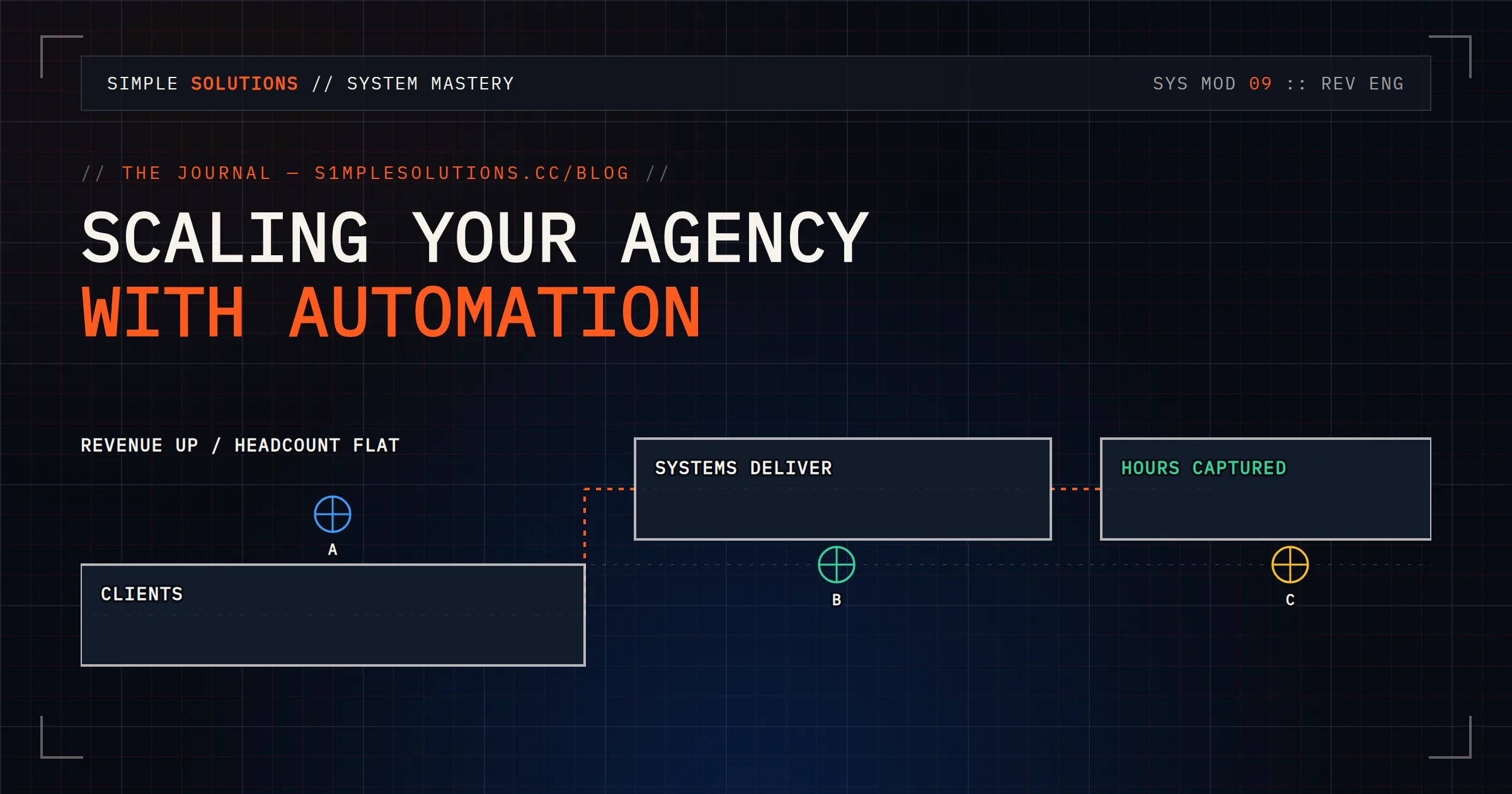
Agencies traditionally scale by hiring. Modern agencies scale by automating, then hiring only into the leverage points the automation reveals.
The Three Universal Bottlenecks
Onboarding, reporting, and approval cycles. Every agency loses days to these every month. Automate them once and the savings compound across every client account you take on.
Productize the Repetitive Work
If a deliverable looks identical across three clients, it is a product. Build it once as a template, automate the customization, and stop charging like it was bespoke labor.
Hire to the Leverage
Once automation has shown you which work actually requires human judgement, hire specialists for that. The goal is a team where every hire is non-replaceable, not interchangeable.
Productize onboarding end to end
The onboarding sequence is the highest-leverage productization target because it repeats for every single client, starts before any revenue review, and sets expectations for the entire relationship. The productized version runs as a pipeline: an intake form collects the specifics no two clients share, the answers flow into a pre-built vertical snapshot that provisions the account, an automated checklist drives the team through the remaining custom steps, and a client portal shows progress without a single status email. Each new client inherits the same foundation that took weeks to perfect for the first, which converts onboarding from a senior-person task into a supervised assembly. The metric to run it against is time-to-value: the days between signed contract and the client's first visible automated win. Agencies that track it find it typically drops from weeks to days, and the shortened cycle lands in every proposal conversation that follows.
Make reporting a byproduct, not an assignment
The second universal bottleneck dies when reporting stops being a task someone performs and becomes a view the system already maintains. The pattern is to treat client reporting as a downstream effect of the automation already running: the same workflows that handle leads, bookings, and campaigns emit the events, so a daily exceptions digest, a weekly snapshot, and a monthly client report can each be generated from live data rather than reconstructed by hand each month. What changes the agency's economics is who pays attention: the team reads a digest of anomalies instead of compiling everything, the client receives a consistent narrative every month without the agency re-creating it, and the month-end reporting crunch that used to consume days simply stops existing. The discipline required is up front: define the numbers a client actually reviews, keep every one of them sourced from the platform's own records, and resist the temptation to add metrics because they are easy to produce.
Understand the capacity curve before you celebrate
Scaling claims deserve a measurement, and the honest one is the ratio of team hours per client as the client count grows. A traditional agency holds this ratio flat or rising: forty more clients needs forty more hours of coordination. An automated agency should see the ratio fall and then flatten at a level where each additional client adds only marginal labor: onboarding events, exceptions, and judgement calls that no workflow can safely absorb. If the ratio is not visibly falling after the first three automation waves, the problem is rarely the technology; it is that the automated workflows were pointed at the wrong tasks, or that manual approval steps were kept in the path out of habit. The useful habit is to compute the ratio quarterly against the retainer structure: when a client's hours per month drop below the retainer's funded hours while quality holds, the margin created is the automation dividend, and it is that dividend, reinvested into the next automation wave, that lets a small team carry a client count that a traditional staffing model would never support.