A recurring systems service is credible when the provider owns defined operating work after implementation: monitoring, incident response, maintenance, controlled change, and evidence. Calling an undefined pool of hours a retainer only postpones scope conflict. Productization begins with an asset boundary, service catalog, response policy, capacity model, and clean handback path.
Create the managed-system register
List every in-scope workflow, integration, environment, credential owner, vendor dependency, data store, dashboard, and runbook. Record business owner, technical owner, criticality, expected operating window, change history, and recovery method. Exclude assets the provider cannot observe or control. The register becomes the basis for pricing, onboarding, incident triage, and exit.
Separate maintenance, incidents, and improvements
Maintenance preserves agreed behavior through dependency updates, secret rotation, data hygiene, and routine tests. Incident work restores a service that has deviated from that behavior. Improvement changes the capability, conversion path, or architecture. Define examples and approval routes for each category so a new workflow or platform migration is not misclassified as a bug fix.
Build tiers from coverage, not attractive labels
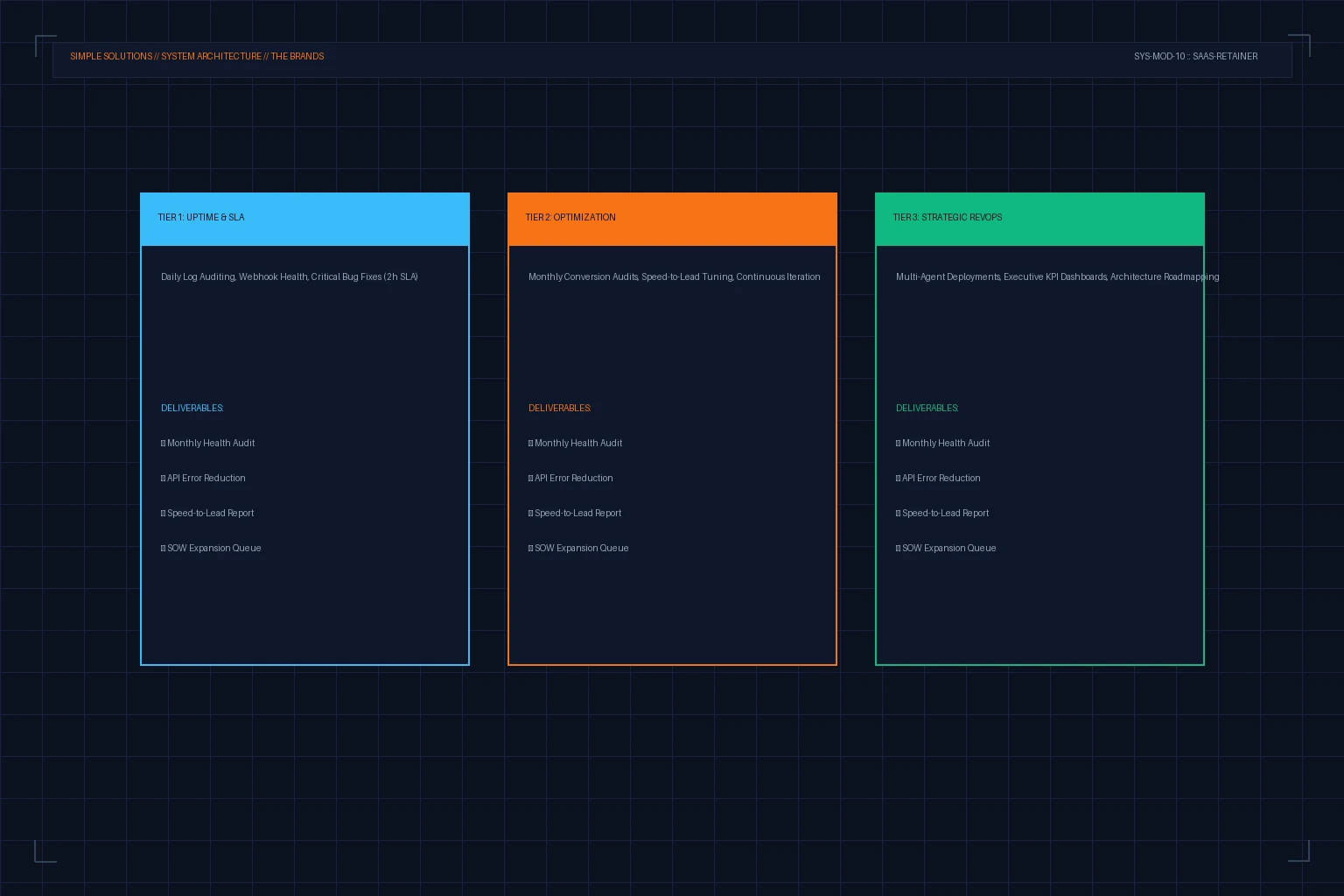
Vary tiers by asset coverage, monitoring frequency, operating hours, response objective, included change capacity, review cadence, and governance access. Keep exclusions explicit: third-party outages, unsupported client edits, net-new platforms, data correction beyond the agreed boundary, and vendor charges may require separate treatment. Do not promise availability that the underlying vendors and support coverage cannot sustain.
The product is a defined operating outcome with evidence and boundaries—not unlimited access to a technician.
Write response objectives and escalation rules
Define severity from business impact, affected users, data risk, and workaround availability. For each severity, state acknowledgement target, update cadence, escalation owner, support hours, and what pauses the clock. Distinguish response from restoration and resolution. Build the targets from staffed capacity and dependency reality rather than copying an enterprise SLA the team cannot meet.
Price the workload and risk explicitly
Estimate baseline monitoring and maintenance, expected incident demand, included improvement capacity, vendor costs, account management, on-call burden, and a risk reserve. Apply limits to concurrent work and define how unused or excess capacity is handled. Value affects willingness to pay, but sustainable pricing still requires evidence that the service can be delivered within its gross-margin and response assumptions.
Report health without inventing attribution
A monthly report should show monitored assets, service-level performance, incidents and causes, failed events recovered, unresolved risks, change capacity used, and next decisions. Include business metrics only when the system can trace them responsibly. Events processed or faster response may demonstrate operation; they do not by themselves prove that the retainer created all associated revenue.
Control change through a release queue
Require a request, expected outcome, affected assets, risk, acceptance test, approver, and rollback plan for each improvement. Prioritize within the included capacity and move larger changes into a separate statement of work. Keep emergency fixes visible in the same change history after the incident so undocumented production edits do not become permanent architecture.
Design renewal and exit from the start
Review the register, service use, recurring incidents, response performance, and future roadmap before renewal. Reprice when asset count, support window, or risk changes materially. Maintain client-owned access, current documentation, credential-transfer steps, open-risk list, and a final export or handover process. A service that depends on withholding operational knowledge is not a durable managed product.