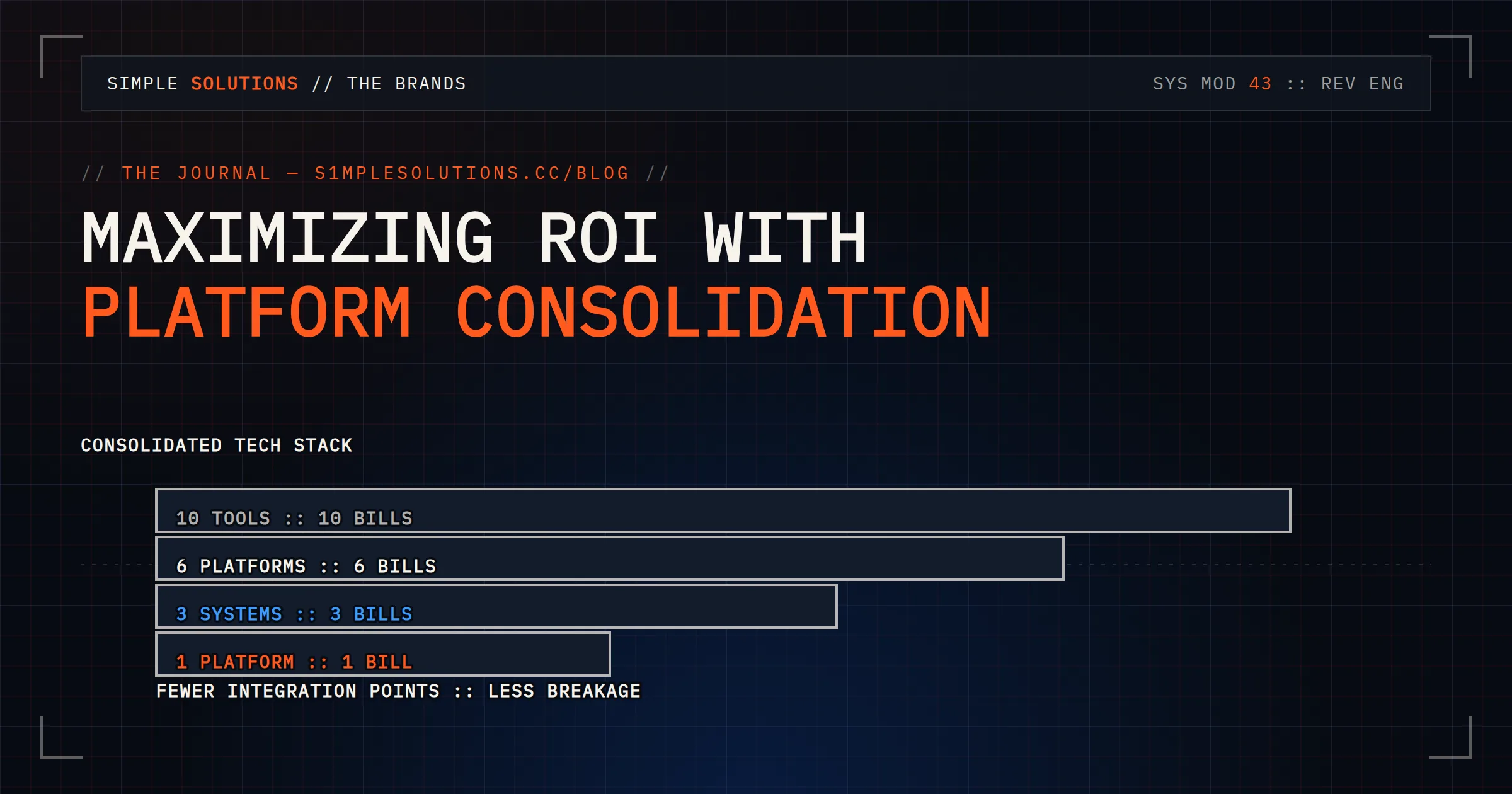
Tool sprawl is the slow leak in most marketing budgets. Ten tools at $99/mo each is more than a senior salary — and most of them overlap.
Audit Before You Cut
List every subscription, who uses it, and what unique job it does. Most stacks have 30–40% redundancy hiding in plain sight.
Consolidate to a Spine
Pick one platform that covers 70% of your needs and let the others orbit around it as plug-ins. The spine becomes your single source of truth and your reporting layer.
The Compounding Win
Beyond cost, consolidation gives you cleaner attribution, faster onboarding, and one place to train AI on. The savings show up in the budget; the leverage shows up in growth.
Count the four invisible costs of sprawl
The subscription total is only the visible layer of a sprawling stack. The first invisible cost is integration glue: every pair of tools that must stay synchronized needs a sync layer, whether that is Zapier scenarios, custom webhooks, or a staff member copying between tabs, and each of those breaks on the provider's schedule, not yours. The second is labor: onboarding a new hire to a twelve-tool stack takes weeks, and every system change means retraining on several screens instead of one. The third is error recovery: data duplicated across systems diverges, and the divergence is discovered at the worst moment, in front of a customer, and the fix consumes senior time. The fourth is opportunity cost, the quietest: reporting across fragments is impossible, so decisions get made on intuition, and attribution stays partial, so budget follows channels that look loud rather than deals that convert. A stack audit that counts only subscriptions captures perhaps a third of the true cost; the teams that consolidate for the visible savings and discover the invisible ones keep the momentum going because the second year is easier than the first.
Migrate in a sequence that never risks the live operation
Consolidation fails most often at the migration, not the decision, because moving everything at once moves the risk all at once. The sequence that protects operations is contacts and identity first, because every other migration depends on a clean, deduplicated foundation; communications next, moving channels into the unified inbox while the old tools remain readable; workflows and automation third, rebuilt on the spine and run in parallel with the old systems for a verification window; and decommission last, with an orphaned-assets checklist run against the old systems: unused API keys, dormant webhooks, scheduled syncs, and automation rules still writing into retired pipelines. Each phase gets a rollback criterion defined before it starts, and the parallel-run window is the part nobody should skip, because it is the only phase where the new system is proven against live traffic while the old one can still catch failures. Rushing the sequence to save two weeks typically costs two months of reconciliation.
Let the unified data train the AI layer
The most underrated payoff of consolidation arrives with the AI workflows now available on the major platforms. An agent can only act on what it can see, and a fragmented stack hands the agent disconnected fragments: the inbox without the pipeline, the calendar without the enquiry history, the form without the follow-up state. On a consolidated spine the same agent answers from the full record, qualifies from the full history, and books with the full context, which is the practical difference between an AI assistant that reads scripts and one that operates the business. The ordering matters too: consolidate first, then automate, because automating on a fragmented stack simply scales the fragmentation, while automating on a unified spine compounds with every workflow added. Teams that follow that order report that each new automation becomes cheaper to build than the last, because the foundation work has already been paid for once.