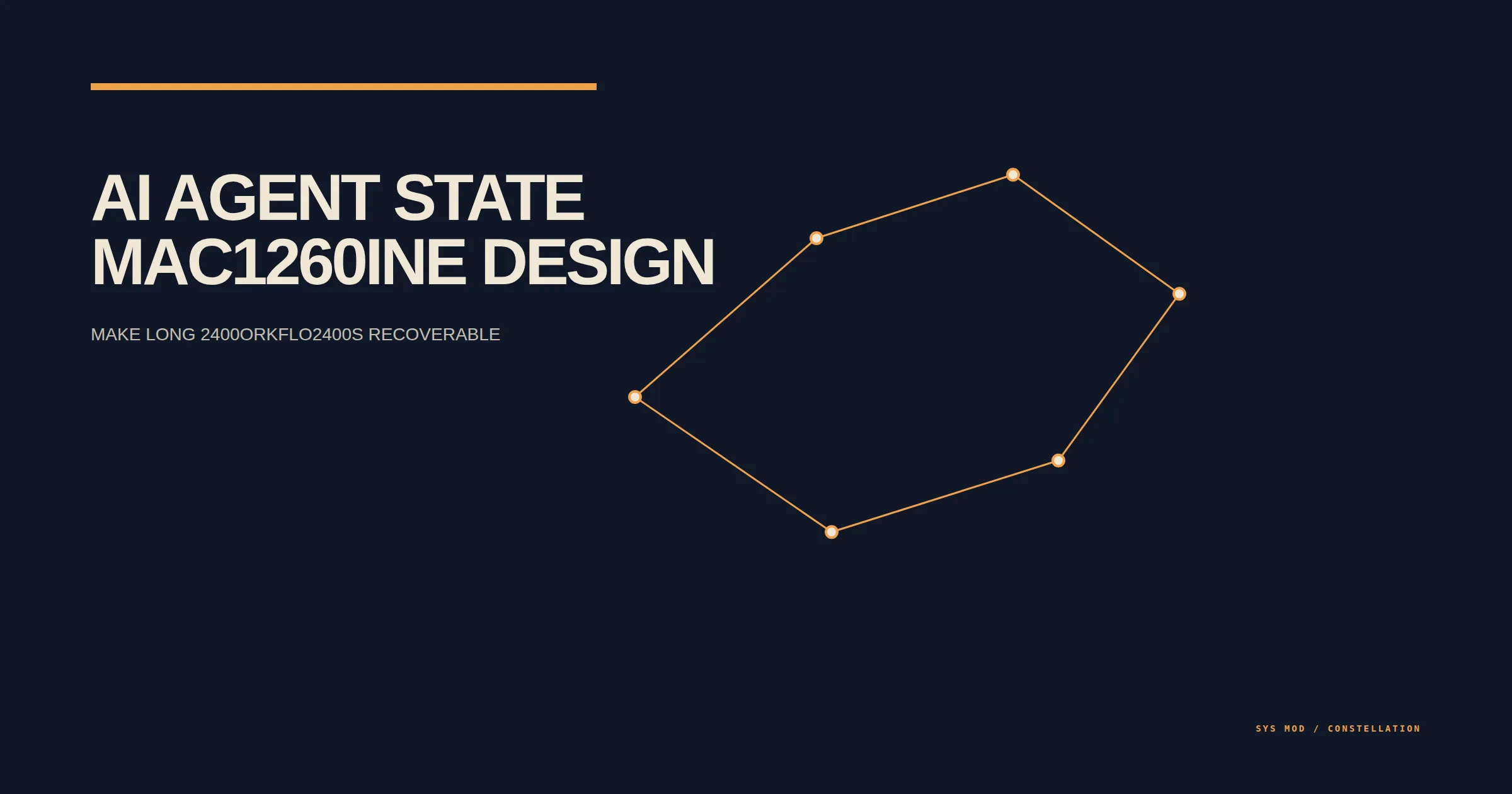
Ai-Agent-State-Machine-Design is an operating decision, not just a software feature. Start by defining the outcome, evidence, owner, and recovery path. For AI agent state machine design, this means making the decision inspectable before automating the movement of data. A useful workflow has explicit states, bounded side effects, and a visible way to pause when the evidence is incomplete.
What ai-agent-state-machine-design must decide
Write the decision in one sentence, then list the inputs, freshness requirements, permitted outputs, and accountable owner. Agents fail opaquely when progress exists only in a prompt, side effects are not tied to states, and a restart can repeat work. Store the reason with the result so an operator can challenge it without reconstructing the entire history.
Separate facts, inferences, and temporary context
Make the data boundary explicit. A state model with durable checkpoints, permitted actions, retry boundaries, pause reasons, and operator overrides. Durable facts need a source, owner, retention rule, and correction path. Inferences need confidence and evidence. Temporary context should expire or be summarized instead of becoming silent business truth.
Model states and safe transitions
Use states such as new, validated, assigned, waiting, completed, blocked, and escalated. A transition should name its trigger and the side effects allowed at that point. This protects AI agent state machine design from duplicate delivery, delayed messages, race conditions, and workers that restart halfway through an action.
Design the exception path first
Define human intervention for missing evidence, conflicting records, sensitive actions, low confidence, and aged exceptions. The review view should show the decision, evidence, attempted action, reason for escalation, and available choices. Keep the handoff compact so the reviewer does not search several systems.
Test failure modes before rollout
Test a worker restart, a partial tool success, a changed permission, a duplicate event, a long pause, and an operator resume. Add duplicate delivery, partial success, permission changes, missing fields, time-zone boundaries, and a provider timeout after acceptance. These cases reveal whether the workflow has a real state model or only a chain of optimistic triggers.
Measure outcomes and operating cost
Track duplicate side effects, recovery time, stuck-state age, transition error rate, and human override frequency. Pair each measure with a target range and named owner. Do not use run count or message volume as the main success metric; activity can rise while quality falls. Measure whether the workflow creates the right state, improves the next decision, and keeps exceptions within an acceptable service window.
Roll out in a narrow slice
Start AI agent state machine design with one source, team, account segment, or workflow branch. Keep a manual fallback and define a stop condition. Compare automated results with a human-reviewed sample, inspect exception quality, and verify downstream state before expanding.
The practical standard for ai-agent-state-machine-design
Treat ai-agent-state-machine-design as a governed capability: trustworthy inputs, preserved provenance, bounded decisions, approved side effects, and accountable exception handling. If one condition is missing, improve the operating contract before adding more automation.
Reliable AI agent state machine design makes the decision easier to inspect, the failure easier to recover, and the owner easier to find.