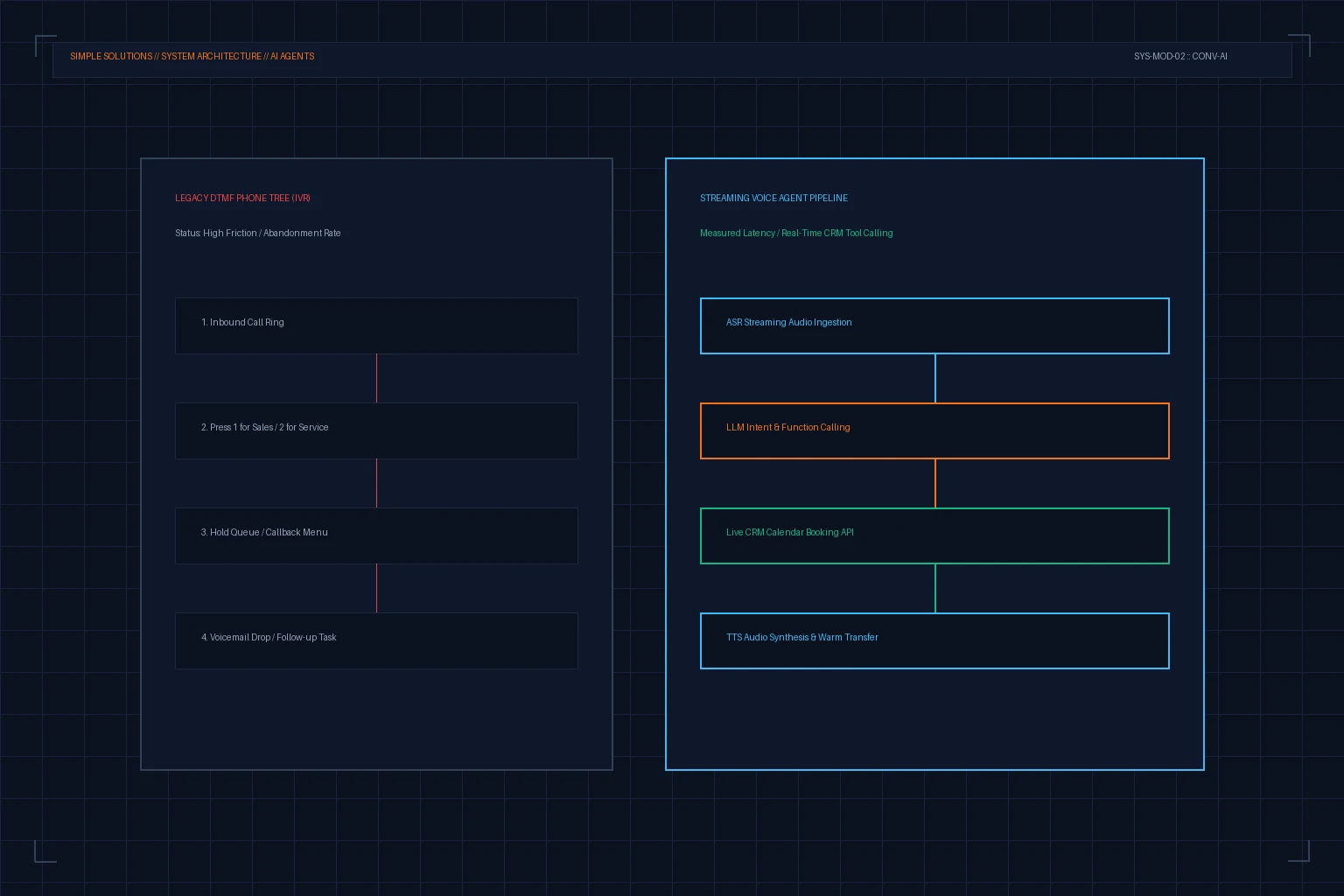
IVR and voice AI solve different routing problems. A short keypad menu is predictable, accessible without speech recognition, and appropriate when callers need only a few stable destinations. A voice agent becomes useful when callers express varied intents, need approved answers, or must complete a bounded transaction. Replacing every IVR with a model adds cost and failure modes without necessarily improving the call.
Choose the simplest architecture that satisfies the call
Keep IVR for deterministic choices such as language, emergency instructions, or department routing. Use a voice agent when natural-language intent materially reduces menu depth or when the call requires a sequence such as identifying a customer, checking availability, and confirming a booking. A hybrid flow often works best: carrier and emergency controls remain deterministic, the agent handles the approved conversational branch, and a keypad or human fallback is always available.
Budget latency by segment and measure it in production
Do not publish one universal latency promise. Instrument caller-end timestamp, end-of-turn detection, model response start, first audio byte, and tool round-trip separately. The acceptable budget depends on network conditions, turn-detection settings, reasoning depth, speech generation, and whether a tool must run. Stream audio when the platform supports it, keep prompts and tool descriptions focused, cache stable context, and test from the actual telephony path rather than a laptop microphone.
A latency target is useful only when each segment is measured and the system has a graceful response when a dependency exceeds it.
Treat turn detection and interruption as product behavior
Voice activity detection decides when the caller has finished and when the model may respond. Aggressive thresholds interrupt thoughtful callers; slow thresholds create dead air. Test noise, speakerphone echo, short acknowledgements, long pauses, and mid-response corrections. When the caller barges in, stop playback, preserve the unheard portion as not delivered, and let the new utterance update the active state rather than continuing an obsolete answer.
Put transactions behind narrow, idempotent tools
The model should not invent availability or write directly to unrestricted CRM endpoints. Expose separate tools for identity lookup, availability search, provisional hold, booking confirmation, contact update, and message delivery. Validate required fields and authorization before each call. Give mutating requests an idempotency key tied to the conversation and proposed slot so a retry cannot create a second appointment.
Confirm consequential details before execution
Repeat names, telephone numbers, locations, time zones, prices, and appointment times in a compact confirmation step. If speech recognition remains uncertain, switch to keypad entry, send a secure link, or transfer to a person. Never let conversational fluency conceal missing evidence; the CRM record should distinguish caller-provided facts, retrieved facts, model interpretation, and the final tool result.
Design transfers and degraded modes before launch
Define triggers for explicit human requests, repeated misunderstanding, complaints, emergencies, policy exceptions, tool failure, and low-confidence identity. Pass a structured summary and captured fields to the receiving queue. If no person answers, return to the caller with an honest callback option and create an owned task. If the model service fails, preserve deterministic emergency and voicemail routes instead of dropping the call.
Cost the choice honestly across the full lifecycle
The initial quote for either option hides the real comparison, which is across deployment, per-call cost, and ongoing maintenance. IVR tends to win on the first line: menus are cheap to deploy and stable once recorded. Voice AI is priced on usage, with business-grade platforms typically ranging from about $0.25 to $0.50 per minute, and a business running thousands of minutes per month should model the call mix, average handle time, and escalation rate before committing. The offset is that a voice agent can resolve transactions an IVR merely routes, which changes the economics per call, not per minute. Practices running well-built agents report that a large share of inbound calls resolve end-to-end, with the remainder reaching staff carrying richer context, and measured deployments show substantial reductions in average handle time on tier-one calls. The honest answer for most businesses is not a binary choice: deterministic controls stay in IVR, conversational transactions move to the agent, and the call-experience budget decides how much each segment is allowed to cost.
A decision matrix that prevents retrofitting
Answer five questions before choosing architecture, because retrofitting a voice agent onto a call type that did not suit it is the most expensive failure mode in this space. First, is the intent set stable, with fewer than a handful of destinations and little variation; if so, IVR is sufficient. Second, does the call require a bounded transaction, such as checking availability and booking; if so, a voice agent with narrow tools is appropriate and a menu would only add frustration. Third, does the caller's intent vary too widely for menus to express without becoming five levels deep; deep menus fail the latency test in another way. Fourth, what tools must the resolution depend on, and are they stable and idempotent; an agent cannot be production-ready against a fragile backend. Fifth, what is the fallback if the model or a tool fails, and is the fallback deterministic; without it, the design does not yet have a recovery path. When three or more answers point to the agent side, design the agent flow; when they point to menus, keep the IVR and spend the budget elsewhere.
The hybrid pattern that most production systems converge on
Production deployments rarely stay pure in either direction. The convergent pattern keeps carrier handling, emergency instructions, and department routing deterministic, places the conversational transactional work inside the agent with approved answer sources, and makes a keypad option and human queue always reachable within a bounded number of exchanges. The agent front-ends what used to be the queue, qualifying callers and completing bookings directly rather than placing everyone in line. This pattern preserves the accessibility properties that make IVR defensible, while capturing the resolution rate and handle-time improvements that motivate voice AI. The migration order matters: move one call type at a time, keep the old flow live in parallel, compare outcomes on the same call types, and expand traffic only when task completion and customer measures beat the baseline rather than merely matching it.
Evaluate outcomes, not just transcript sentiment
Create a test set covering accents, background noise, interruptions, ambiguous intent, no availability, stale knowledge, duplicate booking attempts, tool timeouts, and hostile instructions. Review task completion, booking accuracy, unauthorized-action rate, transfer success, abandonment by call stage, and correction rate. Compare the voice flow with the IVR or human baseline for the same call types before expanding traffic.